
Zen Technologies Order Book 2026: An Overview
Zen Technologies Limited has become increasingly associated with defence training systems, anti-drone solutions, simulators, surveillance technologies, robotics and other defence-related products.
For investors and people following the company, the order book is an important number because it represents business that has already been contracted but has not yet been fully recognised as revenue.
As of June 30, 2026, Zen Technologies reported a consolidated order book of ₹1,239.02 crore. The company reported that this consisted of ₹920.59 crore of equipment orders and ₹318.43 crore of annual maintenance contract (AMC) orders. The company had an order book of ₹1,336.04 crore at March 31, 2026.
The June quarter also illustrates why the order-book number needs to be studied together with execution. During Q1 FY27, Zen Technologies received ₹44.62 crore of new orders and executed ₹141.64 crore of orders.
After the June quarter, the company announced additional orders, including a ₹177.50 crore Ministry of Defence order in July 2026 and a ₹295 crore Ministry of Defence order in August 2026.
This makes the order book an important topic for understanding Zen Technologies business trajectory, but the order book alone should not be treated as a prediction of future share-price performance.
What Is an Order Book?
An order book is the value of contracts that a company has received but has not yet completely executed or recognised as revenue.
For a defence technology company, an order book can include contracts for products and services such as:
- Defence simulators
- Anti-drone systems
- Training systems
- Live firing ranges
- Surveillance systems
- Robotics
- Unmanned systems
- Annual maintenance contracts
- Other defence equipment
The company generally recognises revenue as products or services are delivered according to the relevant contractual terms.
Therefore, a large order book can provide information about potential future revenue, but it does not automatically mean that the entire order-book value will become revenue immediately.
Execution timing matters.
Zen Technologies Order Book at a Glance
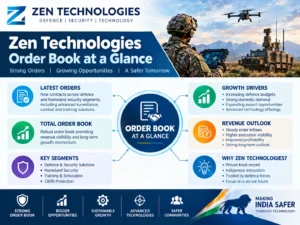
Here are some of the key disclosed figures:
| Period | Consolidated order book |
|---|---|
| December 31, 2025 | ₹1,082.76 crore |
| March 31, 2026 | ₹1,336.04 crore |
| June 30, 2026 | ₹1,239.02 crore |
| July 2026 additional order | ₹177.50 crore |
| August 2026 additional order | ₹295 crore |
The December 2025 figure included ₹987.38 crore of domestic orders and ₹95.38 crore of export orders.
The March 2026 figure increased to ₹1,336.04 crore after ₹431.36 crore of new orders were received during Q4 FY26 and ₹178.08 crore of orders were executed during that quarter.
By June 30, 2026, the consolidated order book stood at ₹1,239.02 crore.
Zen Technologies Order Book at March 2026
The March 2026 order book is an important starting point for understanding FY27.
Zen Technologies reported a consolidated order book of ₹1,336.04 crore as of March 31, 2026.
The order-book calculation disclosed by the company was:
Opening order book: ₹1,082.76 crore
New Q4 FY26 orders: ₹431.36 crore
Orders executed: ₹178.08 crore
Closing order book: ₹1,336.04 crore
This shows that the company added substantially more orders than it executed during the quarter, resulting in an increase in the closing backlog.
The March order book also included ₹121.81 crore relating to subsidiary companies.
Zen Technologies Order Book at June 30, 2026
The June 30 figure gives a more recent picture.
The consolidated order book was ₹1,239.02 crore.
It consisted of:
- Equipment order book: ₹920.59 crore
- AMC order book: ₹318.43 crore
- Total: ₹1,239.02 crore
During Q1 FY27:
- New orders: ₹44.62 crore
- Orders executed: ₹141.64 crore
- Closing order book: ₹1,239.02 crore
Because execution exceeded new order intake during the quarter, the headline order-book figure declined from the March level.
That does not by itself indicate a deterioration in demand. It means that the company executed more existing orders than the value of new orders added during that particular quarter.
This distinction is important when analysing order-book trends.
Domestic and Export Order Book
The June 2026 investor presentation showed a substantial domestic component.
The June 30 order book was divided into:
- Domestic: ₹1,153.77 crore
- Export: ₹85.25 crore
- Total: ₹1,239.02 crore
This means the majority of the reported order book was domestic at that point.
The domestic concentration is relevant because Zen Technologies supplies products into India’s defence procurement ecosystem.
At the same time, export opportunities can provide another potential growth avenue.
Investors should therefore monitor whether the export contribution increases over time rather than assuming that today’s geographic mix will remain unchanged.
What Are the Main Products Behind the Order Book?
Zen Technologies operates across several defence technology categories.
Its product portfolio includes areas such as:
- Anti-drone systems
- Drone and counter-drone technology
- Defence training systems
- Simulators
- Live ranges
- Virtual simulation
- Naval simulation
- Surveillance
- Automated weapons systems
- Robotics
- Unmanned systems
- Operational equipment
The company’s Q1 FY27 presentation highlighted products and technologies covering counter-drone systems, training solutions, naval simulation, drones, robotics and automated weapons systems.
This diversification matters because the company’s order intake does not depend on only one product category.
However, individual quarters can still be heavily influenced by the timing of large defence contracts.
Zen Technologies ₹177.50 Crore Order in July 2026
One of the important post-quarter developments was the ₹177.50 crore order received from the Ministry of Defence in July 2026.
According to the company’s corporate-announcement record, the order was announced on July 22, 2026.
The order related to the upgradation and integration of Tank and Crew Gunnery Simulators.
This is significant from a business perspective because simulator systems are one of the company’s established areas of operation.
The order was received after the June 30 order-book reporting date, so it was not included in the ₹1,239.02 crore June 30 figure.
Therefore, readers should not simply add the July order to the June order book and assume that the resulting number is the company’s current official order-book figure. Orders can be executed, cancelled, amended or otherwise treated according to accounting and contractual disclosures.
The correct approach is to distinguish between:
Reported closing order book
and
Subsequent order announcements.
Zen Technologies ₹295 Crore Order in August 2026
Another important announcement came in August 2026.
Zen Technologies corporate-announcement page records a ₹295 crore Ministry of Defence order announced on August 10, 2026.
The order relates to defence simulators.
This is another example of why order-book analysis should be updated regularly.
A June 30 order-book figure can quickly become outdated when a company receives large contracts after the reporting date.
For this reason, investors researching Zen Technologies should look at both:
- The latest reported order-book figure.
- Material orders announced after that reporting date.
Why Defence Simulator Orders Matter
Simulators can provide defence organisations with a way to conduct training without relying entirely on live operational equipment.
Zen Technologies has developed products across military training and simulation.
Its portfolio includes:
- Tank simulators
- Crew gunnery simulators
- Flight and air simulators
- Naval simulators
- Weapon training systems
- Live firing ranges
- Virtual training systems
The company has stated that it wants to expand training solutions across the Army, Navy and Air Force. Its Q1 FY27 presentation also highlighted its broader training and simulation portfolio.
For Zen Technologies, simulator contracts can therefore contribute to both order intake and the company’s broader defence-training strategy.
Anti-Drone Systems and Future Orders
Another major business area is counter-drone technology.
Modern militaries face the challenge of detecting, tracking and neutralising unauthorised or hostile drones.
Zen Technologies has products and systems related to:
- Drone detection
- Drone tracking
- Counter-drone systems
- Interceptor technology
- Integrated surveillance
- Defence response systems
The company’s Q1 FY27 presentation highlighted an AI-powered anti-drone system, the Hyperstrike interceptor drone and other new products.
The importance of this segment comes from the changing role of unmanned aerial systems in modern warfare.
However, future demand should be treated as an opportunity rather than guaranteed revenue.
Actual revenue depends on procurement decisions, contracts, production capacity, delivery schedules and acceptance by customers.
How the Order Book Can Affect Revenue
One of the most important concepts for investors is the difference between order booking and revenue recognition.
Suppose a company receives a ₹100 crore contract.
That does not necessarily mean it will report ₹100 crore of revenue in the same quarter.
If the contract is executed over several months, revenue can be recognised progressively according to the applicable accounting and contractual arrangements.
This creates a time gap between:
Order received → Production → Delivery → Acceptance → Revenue recognition
For Zen Technologies, this timing can be particularly important because defence contracts can involve specialised equipment, testing, integration and customer acceptance.
Therefore:
A strong order book can improve visibility, but it does not guarantee a particular quarterly revenue number.
Why Order Execution Matters
Consider two companies with the same ₹1,000 crore order book.
Company A executes ₹500 crore during the year.
Company B executes only ₹200 crore.
Their reported revenue outcomes can be very different despite starting with the same backlog.
This is why Zen Technologies investors should track:
- New order inflow
- Order execution
- Revenue
- Order-book conversion
- Gross margins
- EBITDA margins
- Working capital
- Receivables
- Customer concentration
The June 2026 quarter provides a useful example.
Zen Technologies had ₹1,239.02 crore of consolidated orders at June 30, 2026, while ₹141.64 crore of orders were executed during Q1 FY27.
Zen Technologies Revenue and Order Book
The relationship between revenue and order book can be illustrated simply.
Order book
Represents contracted business that remains to be executed.
Revenue
Represents business recognised during the reporting period.
New order intake
Represents new contracts added during the period.
Execution
Represents the progress made against existing contracts.
A useful simplified formula is:
Closing Order Book = Opening Order Book + New Orders − Orders Executed
Zen Technologies’ disclosed figures demonstrate this relationship.
For Q1 FY27:
₹1,336.04 crore + ₹44.62 crore − ₹141.64 crore = approximately ₹1,239.02 crore
That matches the company’s reported June 30 consolidated order book.
What Is the Zen Technologies FY27 Outlook?
Zen Technologies entered FY27 with a substantial existing backlog.
The company said its June 30 order book provided visibility into execution, with the typical execution cycle for these orders around 12 months. The company also indicated that orders received through Q2 FY27 could begin contributing to revenue later in the fiscal year.
This means the FY27 revenue picture should be evaluated over multiple quarters rather than based on one quarter alone.
The company also has an opportunity pipeline covering areas such as:
- Simulators
- Counter-drone systems
- Training systems
- Unmanned systems
- Defence technologies
But an opportunity pipeline is different from a confirmed order.
That distinction should always be maintained in an investment article.
Zen Technologies Order Pipeline
A pipeline consists of potential business that has not necessarily become a confirmed order.
This is different from the order book.
Order book
Contract already received.
Order pipeline
Potential future contracts.
Revenue
Business recognised after execution under applicable accounting rules.
For SEO and investor education, this distinction is extremely important because readers often confuse the three.
When writing about Zen Technologies’ future growth, use phrases such as:
- “potential opportunity”
- “reported pipeline”
- “management indicated”
- “subject to order conversion”
rather than presenting pipeline opportunities as guaranteed revenue.
Zen Technologies’ Defence Market Opportunity
India has continued to focus on domestic defence manufacturing and indigenous technology.
Zen Technologies operates in areas that include defence training, simulation, counter-drone systems, robotics and related technologies.
The company has highlighted the relevance of India’s defence procurement priorities to its product portfolio.
The company’s potential growth therefore depends on several factors:
- Government defence procurement.
- New contract awards.
- Product competitiveness.
- Manufacturing capacity.
- Successful delivery.
- Customer acceptance.
- Export expansion.
- Research and development.
- Competition.
- Execution of the existing order book.
Zen Technologies Order Book vs Revenue: What Should Investors Track?
A useful quarterly checklist is:
| Metric | Why it matters |
|---|---|
| Order book | Shows contracted backlog |
| New order intake | Shows fresh demand |
| Execution | Shows conversion of backlog |
| Revenue | Shows recognised business |
| EBITDA margin | Shows operating profitability |
| PAT | Shows bottom-line profitability |
| Domestic orders | Shows India exposure |
| Export orders | Shows international contribution |
| AMC orders | Shows recurring service component |
| Receivables | Shows cash-conversion quality |
Looking at only one metric can provide an incomplete picture.
For example, a rising order book can look positive, but if execution remains slow, revenue recognition may be delayed.
Likewise, a temporary reduction in order book can occur when execution is faster than new order intake.
What Are the Risks to Zen Technologies’ Order Book?
Order-book growth should not be viewed without considering risks.
1. Order Execution Risk
Receiving an order is only the beginning.
The company must manufacture, integrate, deliver and complete the required acceptance process.
Delays can affect the timing of revenue recognition.
2. Procurement Timing
Defence procurement can involve long decision-making cycles.
Large orders may therefore arrive unevenly across quarters.
This can produce substantial variation in quarterly revenue and order intake.
3. Customer Concentration
A significant portion of Zen Technologies order book has historically been linked to domestic defence customers.
A change in procurement schedules can therefore affect order timing.
4. Export Risk
International expansion can create additional opportunities, but overseas sales involve:
- Regulatory requirements
- Local competition
- Geopolitical considerations
- Currency movements
- Customer-specific certification
- Local partnerships
5. Competition
The defence technology industry contains established companies as well as specialised technology providers.
Winning future contracts depends on technical capabilities, pricing, delivery capability and procurement requirements.
6. Technology Risk
Defence technology evolves quickly.
Companies must continue investing in:
- R&D
- Artificial intelligence
- Robotics
- Drone technology
- Counter-drone technology
- Simulation
- Surveillance
Products can become less competitive if technology development does not keep pace.
7. Margin Risk
Higher revenue does not automatically mean higher profitability.
Input costs, employee expenses, warranty provisions, R&D spending, product mix and operating leverage can affect margins.
Is a Bigger Order Book Always Better?
Not necessarily.
The quality of an order book matters.
A useful analysis should consider:
Size
How large is the backlog?
Execution period
How quickly can it become revenue?
Product mix
What products or services make up the backlog?
Margin
What profitability can the contracts generate?
Customer quality
Who placed the orders?
Payment terms
How quickly does the company collect cash?
Cancellation or modification risk
Can contracts change?
Therefore, simply comparing two companies by order-book size may produce an incomplete conclusion.
Zen Technologies Equipment Order Book vs AMC Order Book
The June 2026 order book consisted of:
Equipment: ₹920.59 crore
AMC: ₹318.43 crore
Total: ₹1,239.02 crore.
The distinction is useful.
Equipment contracts generally involve delivery of products or systems.
AMC contracts relate to maintenance and support.
Maintenance contracts can provide a recurring component to the business, although the economics and duration of each contract can differ.
For this reason, investors should track both equipment and AMC order books over time.
What Could Drive Future Zen Technologies Orders?
Several areas deserve monitoring.
Counter-Drone Technology
The expansion of drone use has increased the need for counter-drone capabilities.
Defence Simulators
Training systems remain an important part of Zen Technologies business.
Naval Training
The company is expanding its simulation and training capabilities into naval applications.
Robotics
The company has been investing in robotics and autonomous technologies.
Unmanned Systems
Drones and unmanned ground systems represent additional technology areas.
International Markets
Export orders could diversify the company’s customer base.
None of these factors should be treated as guaranteed future orders. Actual growth depends on contract wins and execution.
How to Track Zen Technologies Order Book Every Quarter
If you follow ZENTEC, update the following numbers every quarter.
Step 1: Record the previous closing order book
For example:
March 31, 2026: ₹1,336.04 crore
Step 2: Add new orders
Record all material order announcements.
Step 3: Record execution
Find the amount of orders executed during the quarter.
Step 4: Calculate the new closing order book
Use:
Opening Order Book + New Orders − Executed Orders
Step 5: Check domestic vs export
This helps identify changes in geographic exposure.
Step 6: Check equipment vs AMC
This shows the composition of the backlog.
Step 7: Compare order book with revenue
Look at whether the company is converting its backlog into reported revenue.
Step 8: Check management commentary
Management commentary can provide context about execution schedules and procurement timing.
Zen Technologies Order Book: Important Dates to Remember
Some recent milestones include:
December 31, 2025: Consolidated order book of ₹1,082.76 crore.
March 31, 2026: Consolidated order book increased to ₹1,336.04 crore.
June 30, 2026: Consolidated order book stood at ₹1,239.02 crore.
July 2026: ₹177.50 crore Ministry of Defence simulator order announced.
August 10, 2026: ₹295 crore Ministry of Defence order announced.
These dates should be updated whenever the company publishes a new quarterly order-book disclosure.
Frequently Asked Questions
What is the Zen Technologies order book in 2026?
Zen Technologies reported a consolidated order book of ₹1,239.02 crore as of June 30, 2026. It consisted of ₹920.59 crore of equipment orders and ₹318.43 crore of AMC orders.
What was Zen Technologies’ order book in March 2026?
The company reported a consolidated order book of ₹1,336.04 crore as of March 31, 2026.
Did Zen Technologies receive new orders after June 2026?
Yes. The company announced a ₹177.50 crore Ministry of Defence order in July 2026 and a ₹295 crore Ministry of Defence order in August 2026.
What was the ₹177.50 crore Zen Technologies order?
The July 2026 order involved the upgradation and integration of Tank and Crew Gunnery Simulators.
What was the ₹295 crore Zen Technologies order?
Zen Technologies announced a ₹295 crore Ministry of Defence order in August 2026 for defence simulator-related supplies. The company’s corporate-announcement page records the announcement on August 10, 2026.
Zen Technologies Order Book 2026: Latest Orders, Growth & Revenue Outlook
No. An order book represents contracted business that remains to be executed, while revenue represents business recognised during the relevant accounting period.
Does a larger order book guarantee higher profits?
No. Profitability depends on execution, product mix, pricing, costs, margins, working capital and other factors.
How often should Zen Technologies’ order book be checked?
The best approach is to review it whenever the company publishes quarterly results or announces a material new contract.
Where can I find official Zen Technologies announcements?
Zen Technologies publishes corporate announcements, financial information and investor-related documents through its investor-relations resources. Its corporate-announcement page lists material order announcements and other disclosures.
Final Thoughts on the Zen Technologies Order Book
The Zen Technologies order book is an important indicator for understanding the company’s future revenue visibility, but it should not be considered in isolation.
The company reported a consolidated order book of ₹1,336.04 crore at March 31, 2026, followed by ₹1,239.02 crore at June 30, 2026. The June figure consisted of ₹920.59 crore of equipment orders and ₹318.43 crore of AMC orders.
The subsequent ₹177.50 crore simulator order in July and ₹295 crore Ministry of Defence order announced in August show why investors need to distinguish between the latest reported backlog and orders received after the reporting date.